Is Blackwood Open World? The Direct Answer for Players
No. Blackwood is not open world, and the collected guide source says so directly. You spend most of your time inside a single apartment building — starting the day in your room, working in the DVD store on the first level, and deploying to missions from a hideout in the basement. Missions themselves are isolated in dedicated sandboxes, so there is no exploration loop needed to unlock locations or checkpoints.
- Open world
- No — stated directly by the collected sources
- Mission structure
- Isolated, dedicated sandboxes
- Main locations
- Apartment, DVD store, basement hideout
- Day-to-day hub
- One apartment building
- Free roam driving
- Not available
- Steam genres
- Action, Adventure, RPG, Strategy
The three floors you actually play in
The game's world is unusually small and unusually vertical. You start each day in your apartment, walk down to the DVD store on the first level of the same building, and reach your hideout through a door at the end of the hallway, down in the basement.
Almost every non-combat system lives in that building. The store handles income and management, the basement handles weapon modification, takedown choreography, your ammo and weapons stashes, and the computer that runs Dark Mail and the black market.
When a main mission is complete, the game returns you to the apartment building automatically. You then sleep in your bed to close out the day, which saves your progress and advances to the next day. There is no walk back across a map, because there is no map to walk across.
Missions are sandboxes, not regions
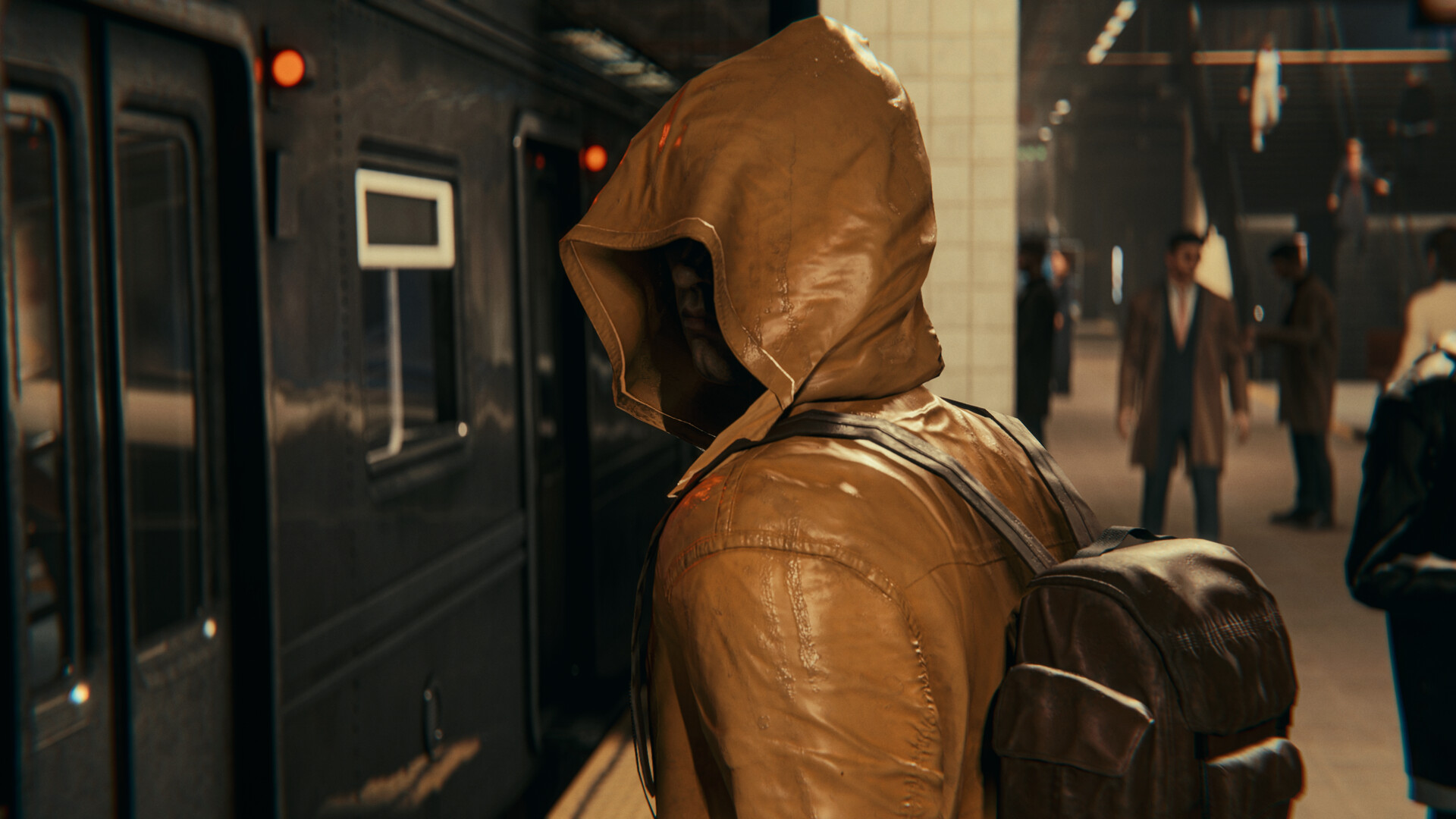
Each mission drops you into a purpose-built space: the sewers under the city, a plaza, a train station, a warehouse. These areas are self-contained levels that exist for a single job rather than parts of a connected world.
The walkthrough for the first mission makes the boundary explicit. During the plaza firefight it notes that the area is not open, and that you will encounter invisible barriers around the edge of the sandbox, which limits repositioning and flanking. That is the defining difference between a Blackwood mission and an open-world district.
Inside those sandboxes the design is quite dense. The first mission alone chains a tunnel traverse with tutorial cover, vault and crawl prompts, a control room with five levers and a gate sequence read off a folder, a crocodile in murky water, and then a multi-wave firefight across a plaza to reach your car.
Why it can look open world from the outside
A few things on the store page and in trailers can give the wrong impression. The game has a muscle car, and there are driving sections, which reads like free roam until you actually control it.
The guide is direct about this: driving is not an integral part of the game because you cannot really drive around and explore the city. The car exists to move you through mission content, with W, A, S and D for accelerate, turn and brake and the spacebar as a handbrake.
The 2012 New York setting does the rest of the work. A city setting plus a car plus a night-time assassin premise sounds like the open-world template, and Blackwood deliberately borrows that imagery without copying the structure.
Storage and structure back this up
The structure shows up in the technical data too. Steam lists the game under Action, Adventure, RPG and Strategy, and none of those tags is an open-world tag. The store page also reports a 30 GB install size for both minimum and recommended specs, which is small next to the 100 GB-plus footprints that map-heavy open-world games usually carry.
The content model is another signal. Blackwood ships as a single purchase structured into three Acts, with later Acts delivered as free updates. That is how a mission-driven game scales, not how a persistent world does.
What replaces exploration
Instead of discovering locations, the game gives you a management loop to optimise. The DVD store has four weighted popularity categories: stock accuracy at 45%, customer service at 45%, organisation at 5% and cleanliness at 5%. Getting those numbers up is the long-term progression that an open world would normally provide through exploration.
Your daily routine is the other substitute. Each day you freshen up, change clothes, eat breakfast for a small HP bonus, check your mail or order DVDs, and then work the store until it closes at 7PM. After that, the night half begins and you take on a contract.
You can only take one mission per day, whether or not you complete it. That limit exists because the day is the unit of progression — there is no wandering off to fill time between objectives.
Does the lack of open world hurt it?
That depends on what you want from the game. If you are looking for a city to explore at your own pace, Blackwood is not that, and no amount of mission variety changes the answer.
If you want a tight third-person action game with a systems-heavy day job attached, the closed structure is the point. The store management, the economy split between clean and dirty cash, and the one-mission-a-day rhythm all depend on a small, controlled hub rather than a sprawling map.
The honest framing is that Blackwood is a mission-based single-player action thriller with a management sim bolted to the front of it. Open world is the wrong shape for what it is doing.
Side content lives in a list, not on a map
Because there is no map to fill, the game's optional content is handed to you as lists rather than as markers on a world. Your hideout computer runs Dark Mail, which the guide describes as the dark web equivalent of a normal mailbox: main story missions appear at the top, while invites and contracts appear at the bottom.
The documented invite list carries its own payouts, which is a good illustration of how the game doles out content without a map to explore:
- Shooting Drill Range — $30/hour
- Prove Yourself — $312
- Last Man Standing — $2200
- Irongate Trials — up to $8000
- The White Tiles — $5000
The contract list is a separate pool with its own rewards: "Unit Verify" at $1200, "Bottle Service" at $2000, Stunt Work I at $1250, Stunt Work II at $2200 and "Smoke Break" at $3500.
Not all of those are combat jobs. The Shooting Drill Range invite is described as a trip to a shooting range rather than a mission, where you bring your own gear, practise or test weapons, and are ranked on how fast you clear the targets. You leave by interacting with your motorcycle and return to the apartment.